Disney World Tickets Compared: Which Type Pays Off
The ticket question arrives whenever a group has four days rather than seven, and the stall is not really the price. It is whether anyone will still want to change parks at six in the evening, after ten kilometres of walking and a lunch that took an hour to find.
I priced the three options for the same October week and then tested them across two trips, one with a base ticket in hand and one with the hopper paid for. The figures come from the official ticket store in September, for four days, before tax, and they move by a few dollars with demand rather than with the season.
What follows is not a review of the parks. It is the arithmetic I run when someone hands me a budget and asks which piece of paper to buy at the counter.
| Ticket | 4 days, per adult | Extra per day |
|---|---|---|
| Base, one park a day | About 400 dollars | Zero |
| Park Hopper | About 500 dollars | About 25 dollars |
| Hopper Plus with water parks | About 540 dollars | About 35 dollars |
| Afternoon single upgrade | Set by date | About 65 dollars a day |
Price: what the upgrade really adds
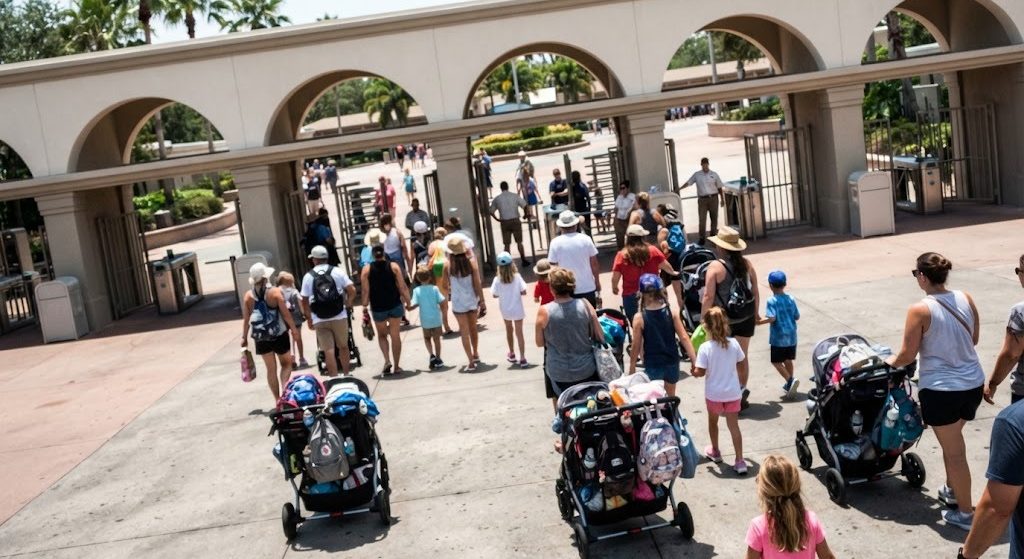
The hopper adds about 25 dollars a day on a four day ticket, which is 100 dollars for a family of four before tax. On a seven day ticket the same add-on drops nearer 17 dollars a day, so the upgrade gets cheaper exactly when you need it least, because a long ticket already gives every park its own day.
That is the whole arithmetic. The add-on is a flat fee for flexibility rather than a discount, and nobody earns it back by using it once. There is a smaller version of the same decision at the gate: a single afternoon upgrade costs about 65 dollars, so buying the hopper for three days of a four day ticket is usually cheaper than upgrading on the days you actually use it.
Children under three cost nothing on either ticket, which cuts the family total by a fixed amount and makes the percentage feel larger than it is. I have watched groups argue about an upgrade worth less than a nappy run.
Hours: the evening nobody uses
Parks run from roughly nine until nine or ten at night, and the hopper opens the second park from two in the afternoon onwards. In practice my group used it on three days out of four, and on the fourth I stood at a gateway at six, looked at the crowd and went back to the hotel instead.
The parks that benefit are Hollywood Studios, which finishes a full day by early evening, and Animal Kingdom, which closes earliest. Magic Kingdom is the park you do not leave. On the trip where I held the hopper, the second park entry was used twice in four days, and one of those two was a mistake: I arrived at a closed show and rode one thing before walking back.
Heat, walking and the cost of a switch
A switch between parks costs about 40 minutes door to door: walk to the gate, bus or monorail, security again, then walk from the arrival point into the rides. In August those 40 minutes happen in full sun, and the group pays for them twice, once going and once coming back.
I keep a simple rule for the hops I actually take: only when both parks sit on the same transport line, and only when the second park has something named on the evening list rather than a vague intention to see more. The counted cost of a switch is lower in January and higher in July, and the difference is not the transport, it is how the group handles the twenty minutes in between.
Who should pay for it
The upgrade pays in a narrow set of cases, and the rest of the time it is a comfort purchase. The comfort is real, and there are weeks when I would pay for it anyway, but it should be bought with open eyes rather than bundled into a package that hides it.
- Buy it for a first visit of three days or fewer, when each park cannot get its own day.
- Buy it if teenagers are riding and the adults are watching, because the groups split and rejoin.
- Skip it for a seven day trip with children under six, who will collapse before two in the afternoon anyway.
- Skip it if the hotel sits far from the transport hub, since the switch eats the evening.
Verdict, with the exception
For four days or more I take the base ticket and spend the 100 dollars on a table service dinner and a rest afternoon, which the group uses harder than a second park entry. The exception is a three day trip with teenagers, where the hopper turns three separate days into one continuous run and the time lost to the switch comes back as rides not repeated.
The test I use at the checkout is whether the second park has a named ride on it. If I can name the ride, the hopper earns its 25 dollars; if the answer is that the group will see what it feels like, the base ticket is the better buy.